
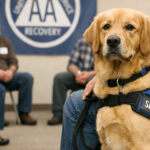
Service Dogs in AA
March 18, 2026
The Meeting – My Story
March 31, 2026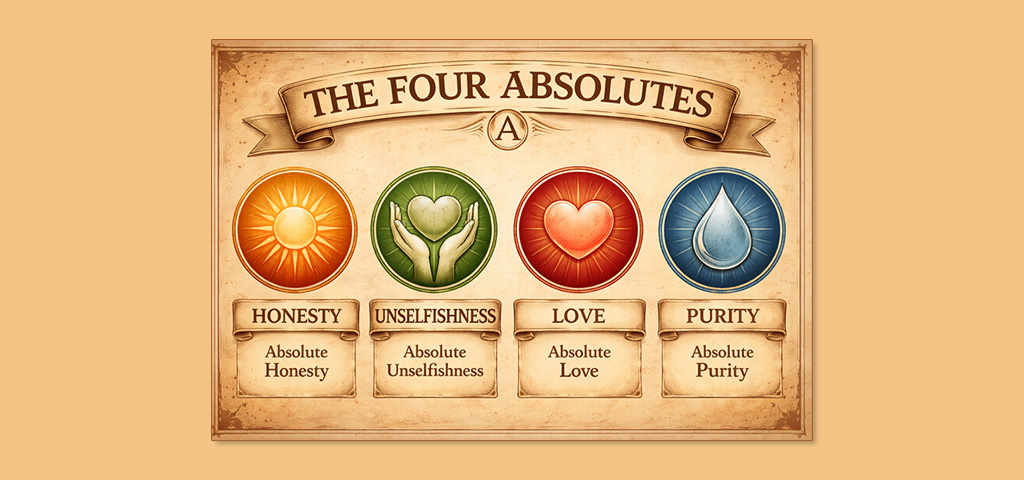
The Origin of the Four Absolutes in AA History
I was asked to research the origin of the Four Absolutes and the pamphlet by that same name published by our office. We have scant local resources for research of this kind, so I reached out to the Archives Department at our General Service Office. It was assigned to Associate Archivist Steven D’Avria who spent considerable time and careful effort on this task. Thank you so much, Steven! I blended his research with ours.
The Four Absolutes come from the Oxford Group, a precursor of AA. Both Bill W and Dr. Bob attended their meetings before starting AA and for a few years thereafter. We were originally the “drunk squads” of that organization. The book “What is the Oxford Group” presents these four moral principles (Honesty, Unselfishness, Love, Purity) in great detail but offers no advice from whence they came. The book “The Oxford Group: Its History and Significance” describes these as: “The ethical program of the [Oxford] Group is epitomized in the counsel of moral perfection defined by the Four Absolutes.” It further details much of the sources of the OG’s tenets and suggested that the Four Absolutes themselves originated from the works of Presbyterian Minister Robert E. Speers.
When asked why the Absolutes were omitted from the Big Book, Bill stated “The Four Absolutes… are expressed or implied in the Twelve Steps. Bill W also opined that their “moral perfection” was too lofty a goal for most alcoholics; “We claim spiritual progress rather than spiritual perfection.” Bill also strongly wanted to differentiate AA from the OG. The OG had experienced some public controversy which we needed to avoid.
Nonetheless many AA members hereabouts found and find these principles of such universal usefulness that Lloyd H, co-editor of Cleveland’s Central Bulletin, wrote essays on these principles as they apply to AA members. They were published in serial form in the January to June 1960 issues. These received such wide acclaim that in October 1962 we decided to publish them in pamphlet form. They first appeared as a 16-page booklet in April 1963 but the oldest copy we have in the office archives was printed after 1974.
I and others, facing indecision, rely on these as a touchstone of God’s will for me—the moral path to pursue. Dr. Bob spoke of this at length in his last major talk in 1948.
By Bob McK, Cleveland District Office Archivist, December 2017
The Four Absolutes – Excerpt
Taken from Dr. Bob’s Last Major Talk, Detroit, December 1948
“The four absolutes, as we called them, were the only yardsticks we had in the early days, before the Steps. I think the absolutes still hold good and can be extremely helpful. I have found at times that a question arises, and I want to do the right thing, but the answer is not obvious. Almost always, if I measure my decision carefully by the yardsticks of absolute honesty, absolute unselfishness, absolute purity, and absolute love, and it checks up pretty well with those four, then my answer can’t be very far out of the way. If, however, I do that and I’m still not too satisfied with the answer, I usually consult with some friend whose judgment, in this particular case, would be very much better than mine. But usually the absolutes can help you to reach your own personal decision without bothering your friends.
“Suppose we have trouble taking the First Step; we can’t get quite honest enough to admit that John Barleycorn really has bested us. The lack of absolute purity is involved here – purity of ideas, purity of motives. Absolute unselfishness includes the kind of service I have been taking about – not the dime or two bits to the bum, but actually giving of yourself.
“As you well know, absolute love incorporates all else. It’s very difficult to have absolute love. I don’t think any of us will ever get it, but that doesn’t mean we can’t try to get it. It was extremely difficult for me to love my fellowman. I didn’t dislike him, but I didn’t love him, either. Unless there was some special reason for caring, I was just indifferent to him. I would be willing to give him a little bit—it didn’t require much effort. I never would injure him at all. But love him? For a long time, I just couldn’t do it.
“I think I overcame this problem to some extent when I was forced to do it, because I had to either love this fellow or attempt to be helpful to him, or I would probably get drunk again. Well, you could say that was just a manifestation of selfishness, and you’d be quite correct. I was selfish to the extent of not wanting Bob hurt; so, to keep from getting Bob hurt, I would go through the motions of trying to be helpful to the other fellow. Debate it any way you want to, but the fact remains that the average individual can never acquire absolute love. I suspect there are a few people who do; I think maybe I know some who come pretty close to it. But I could count them on the fingers of one hand. I don’t say that in any disparaging manner; I have some wonderful friends. But I’m talking about the final aspects of absolute love, particularly as it applies to A.A.”

Staff
The views and opinions expressed in this article are those of the author and do not necessarily reflect the policy or position of the AA Cleveland District Office.
You might also like...




2 Comments
-
 SMITH H. says:
 Regarding AA’s use of the Absolutes, Bill wanted to make a clean break with the Oxford Group (OG). When he and Hank Parkhurst were putting together the Big Book in the Honor Dealer’s office, they would use the term “That’s too groupie” to express dissatisfaction with something the other proposed and was a well-liked term for dissatisfaction. Also, surrender was a big deal in the OG. Guess what word doesn’t appear in the First 164? “Surrender.”
The excellent article about the Absolutes also mentions other efforts in the very early “Flying Blind” period to widen the gap between what became AA and the OG. I particularly like Bill’s comment to the effect that the Absolutes were too highfalutin for most AA’s.
Regardless, it is said that the OG and Sam Shoemaker were major influences of our Big Book.
Tommy H
Danville, KY -
 Levity says:
 true, now 21 years sober, and I have this. thank you.
All comments are reviewed for anonymity. Learn More